
‘Heroes of Might and Magic 2’ scratches the nostalgia just right
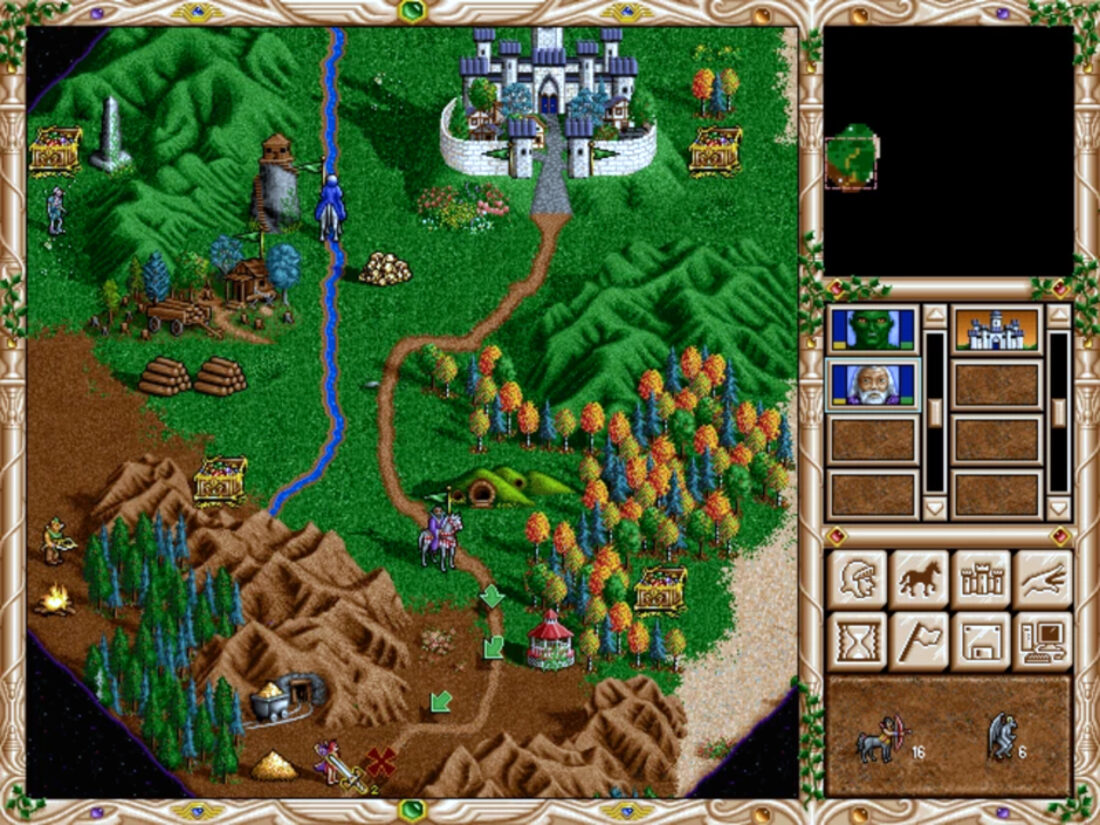
PHOTOS PROVIDED The adventure map shows off the bright and colorful style that helps to make HoMM2 so evocative.
This is one kind of a mix of Bit-by-Bit and Throwback Thursday, as this game is from 1996. Back then, little Arianna didn’t have the best idea of how to be successful at computer games. She would just kind of find demos, download them — carefully, the early internet was the Wild West — play them for a bit, and then move on to the next thing that caught her eye.
“Heroes of Might and Magic 2” (HoMM2) was different. It was special.
A turn-based strategy game, HoMM2 existed in the same “just one more turn” 4x space that Sid Meier’s Civilization came to dominate. In it, the player is the leader of a town of fantastical creatures, and uses Heroes — some specialized for war, e.g., Might; and others specialized for, well, Magic — to stake claims on resource nodes, fight neutral monster camps for artifacts, and conquer other players, controlled by the computer.
The demo for this game featured one scenario, with the player able to choose one of three different starting locations. While the map was the same every game, monster camps, resources, artifacts, neutral towns and the like were all randomly selected from a pool of available options. In addition, all six factions were available in the demo.
Many fantasy stalwarts were represented across the six town:
— Sorceresses comprised of woodland creatures like elves, druids, and unicorns
— Wizards mixed alchemical creations, like golems and titans with mystical wildlife, like rocs
— Knights were human towns, with different troops types including swordsmen, rangers, and cavaliers
— Barbarians united brutish tribes of goblins, orcs, ogres and trolls
— Necromancers raised the dead to fight for them, with troops ranging from skeletons and zombies to more powerful examples like vampires and liches
— Warlocks had a more classical focus, with gargoyles, minotaurs, hydras — and, iconically, black dragons.
Each town had different resource requirements, which forced the player to adjust strategies based not only on what town they started with, but also based on what towns you conquered and built up.
You see, each town started out very simple: just a castle, a tavern to hire heroes, and a basic troop dwelling or two. The player has to build the town up, with various buildings requiring other buildings as prerequisites — and you can only build one building per town per turn.
At higher difficulty levels, the computer starts with many more resources than you do, which means you are often under a significant time crunch to get your hero and forces built up before your neighbors arrive and look to conquer your lands.
I would be remiss if I didn’t mention the power that magic holds in this game, especially with regards to the overworld.
Without going into too much detail, suffice to say that there are spells such as Dimension Door which allow for a hero — and its army — to teleport a screen’s width away.
That demo map that I mentioned earlier? The one that I played for years on end, on and off? It featured a fully built wizard town on an island in the bottom right of the map, which could only be controlled by the computer. And sometimes, some percentage of the time, that player would start with Dimension Door unlocked — and the map had two or three tiles which were just barely close enough to the mainland that they could teleport across and swiftly take over the entire map with their dramatically more advanced army.
It took me a long time to figure out how to counter that move, but that challenge motivated me and kept me coming back for more.
As an adult, I’ve since acquired the full game, and most aspects of it hold up very well. The gameplay is still snappy and fresh, although the balance can be questionable sometimes.
The game also had a very bright, stylized style which has held up very well to this day, and an astonishingly good soundtrack for its time.
And when I say to this day, I mean that I have played this game within the last week — certainly as of my writing, and probably as of your reading.
HoMM2 just has a special spark to it.
Its sequel, 1999’s HoMM3, is ostensibly a better game. It is much better balanced, frankly, and it has a thriving online community that has kept the game alive and even released fan-made expansions. I play that one too, sometimes.
But HoMM2’s raw charm, and its mix of simplicity and depth endures regardless. Perhaps it’s just the nostalgia talking, but when I want a comfy, cozy game, HoMM2 is always near the top of my list.
HoMM2 received many accolades at the time which are now amusingly dated — for example, PC Gamer called it the 7th best PC game of all time…in 1998. There have, in fact, been some good games released since then.
It is available on PC only, via gog.com, for about 10 bucks — give or take a sale price. It is also allegedly possible to play in-browser for free, although I have not tried that personally.
— — — —
Arianna McKee is design editor for The Express.
Arts and Culture
DLH, Roxy Theatre, Beyond the Bell team up for screening of teen mental health movie
The 37th Annual Music Picnic Series at South Hills announced
STATE COLLEGE — South Hills School of Business & Technology has announced the line up for this year’s ...
France reckons with Nazi-looted art in a new Paris museum gallery
USPS unveils Route 66 centennial stamps, born from a photographer’s 42 trips

In a low period for comedy films, these were the best of the last decade
Met gala guests deliver works of art on the human form
New York (AP) — Whether dressed in a jewel-encrusted skeletal form, sculpted breast plates or anatomy-evoking ...