
Council begins developing plans for city hall renovation
Roberts: $1M USDA grant still available for use
Trending
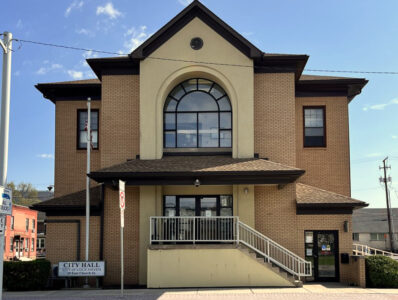
LOCK HAVEN -- Lock Haven City Council spent an almost hour-long work session developing the early plans for renovating its city hall this week.
Following council's split decision last month not to move ahead with the proposed police building, its members at the time noted it needed to act quickly to adjust course in improving its current building -- particularly the Lock Haven Police Department's locker rooms in the basement.
It was noted by City Planner/Interim Manager Abbey Roberts the city had two funding opportunities: the $2.1 million borrowed funds from 2021 and the $1 million USDA grant.
When council elected to forgo the police building, Roberts, at the time, said she needed to see if the USDA grant -- awarded by former Senator Bob Casey in 2023 -- could be transferred from a new building to renovations.
At Monday night's work session, Roberts said it could, much to council's excitement. She noted the city would need to submit an application that clarifies it would be used for renovations, but the money was already earmarked.
"The money is still directed to the city, so we won't lose it if the application isn't 'approved,'" Roberts told The Express. "It's more of a formality so USDA is aware of our plans for the funds."
On Monday night, Roberts said the $500,000 Local Share Grant Funding could not transfer to the renovations..
"We'll take the bigger one," Council member Micah Clausen said.
Council member Jeff Brinker noted, too, this could increase the opportunity to council's proposed phased approach to improvements in city hall.
During its discussions, council outlined various information it would like to see collected by city staff while it continues to solidify how it would move forward with renovations.
A focal point of the work session centered on what improvements can be made for the police department.
Council member Barb Masorti said she felt there were many areas of neglect in the department's current facilities, particularly its locker rooms in the basement.
"There's a shower down there that hasn't been repaired in some 30 years," she said.
Masorti noted repairs to the current facilities, such as the locker rooms, showers and potential relocation of the women's locker room, to make it a more adequate space could be done without getting caught up in permitting and planning processes.
"We don't need a permit, we don't need architectural drawings, we don't have to ask to waive any sort of ADA compliance to fix the shower and police locker rooms," she said.
She noted the upgrades could deplete the budgeted funding, but would at least improve the spaces enough for longer term goals.
Brinker said he liked Masorti's idea of simplicity.
"We're stewards. What can we do to keep it as simple as we possibly can?" he asked. "The more we move, the more challenging it gets," Brinker said.
He noted, much like Masorti has previously commented on in past discussions, that more intense construction of city hall could open up new complications. He added he'd like to see plans and phases that will have the least disruption for staff.
"What can we do to make it the least disruptive? Because it's going to be a working environment," he said. "If we can keep it less disruptive, minimum costs and efficient I think that's a win-win. I don't think we need to blow up the building and make astronomical changes."
Masorti asked Chief Matthew Rickard his thoughts on potentially improving the current spaces for the police department.
"Certainly the locker rooms are a concern. I have to point out one of the major concerns is the women's locker room, which shouldn't even be a women's locker room right now," he said. "I think that's a high priority for a variety of reasons."
He said if he were to prioritize these items, the general working conditions for the staff would also be a high priority.
"There are holes in the floor, tiles ripped up and the furnishings are terrible," he said. "We get hand-me-down chairs. I do think those would be a very close second for priorities. Making it more efficient and more operational in the department."
He noted the department's current offices, located on the first floor in the rear of the building, are a bit tight.
"Officers are on the phone talking to people in the patrol room, there's a secretary on the phone talking to someone and you have another person on the phone... that's not efficient," he said.
Masorti noted council can look into rearranging some of its current office spacing, pointing out the water clerk could, in theory, move to the Public Works Department on Second Avenue with the remainder of the water department to free up space.
"We could make some maneuvers of people... and open the space for the police department," she said. "I'm just trying to think of ways to do this without tearing this building up."
Rickard said if that were to take place, it could be possible to keep the locker rooms on the basement level. However, he said the storage of police documents needs to be addressed.
If the records were moved to the second floor, in a storage room in the rear of the building, Rickard noted they could be secured and in a more temperature controlled environment than they currently are.
The space on the second floor currently houses documentation for the Community Development Block Grant (CDBG) process that must be kept for at least 20 years and documentation for the redevelopment authority among others.
It was suggested these documents be moved to another space, with the police records taking up the second floor storage.
Rickard said this would free up an area for a potential expansion for renovations of the locker rooms.
Codes Officer Cyndi Walker cautioned council these plans would still require the same level of planning and documentation as any other commercial developer if they chose to go that route.
"You're having to meet anything that any commercial developer would have to meet in the same circumstances," she said.
Mayor Joel Long noted no matter what council chooses to do in the immediate future, it needed to be part of an overall, phased plan.
"Whatever we do now, it's not over. It's an ongoing thing. We should still have a long-term goal on how we'd like to do this," he said.
He asked council if keeping the locker rooms in the basement would have an effect on the longer-term goal. Previously, council discussed the possibility of moving the locker rooms to the second floor. Clausen asked staff to find out how it could waive the ADA compliance requirements if it chose to place the locker rooms at the current code enforcement offices, which has a small set of stairs to reach the space.
"I think less is more when we do this. We achieve a long-term goal with this building by saying there's a functional floor plan that's here. It's not great, but once we start tearing this building up and it's torn up, we have to deal with the consequences of that," she said. "I just think an old building like this would be something we might come to regret. That's my personal fear."
Council member Rick Conklin asked a number of questions, which staff said it would gather information on that included: Can a water testing meter located in the basement be moved to allow more room for renovations; has the building been tested for lead or asbestos to be remediated and noted council and staff would need to begin including a building improvement line item into its budget in the coming fiscal years.
"None of us is going to like it because it'll cause an increase, but at least then we can say we're taking care of your building," he said.
Ultimately, council by majority came to an agreement to explore improvements of the current locker rooms and police department space as a potential phase one of its improvement project.
In the meantime, Rickard requested the police files be moved to the new space on the second floor, which council agreed to.
City staff were also directed to speak with the city's architect, Buchart Horn, to develop potential improvement plans.
"Buchart Horn is already familiar and has the plans, so it might be advantageous to reach out to them for cost estimates," Roberts noted. "I think the most costly move would be if you'd have to start over and do those investigations again, which they already did."
Walker agreed with Roberts' assessment.
Council member Heather Alexander, who said she was a bit disappointed the potential plans didn't include moving the locker rooms out of the basement -- but understood the need to exercise caution when moving forward with these plans -- asked Rickard if his officers would feel okay with moving in this potential direction.
"I can't answer for them just yet. I need to see something and talk with them. If they're against it, I'll let you know and the reasons for it," he said. "I think with a well thought out, designed plan, who knows what we'll run into. We might be talking about something different once we look at it."