
Ceramic trees are a Christmas staple
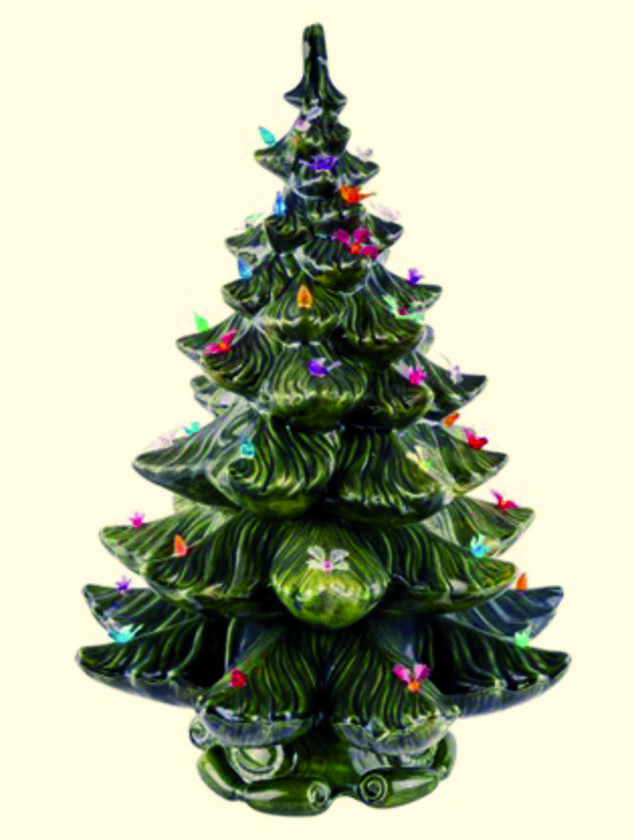
Artificial Christmas trees have been around since the 19th century, if not earlier. Trees made of dyed feathers originated in Germany and were introduced to the U.S. by the early 20th century. The mid- to late-20th century saw trees made from several new materials. There were some made of brush bristles. The famous aluminum Christmas trees, sparkling in silver before any lights or ornaments were added, were first made in the 1950s. New types of plastic that gained widespread use after World War II proved to be perfect for making durable, realistic-looking synthetic pine needles. But one tree trend of the 1950s to 1970s used a very old material: ceramic.
Small ceramic Christmas trees measuring between 12 and 24 inches were just the right height to display on a table — and still are, to the many families that kept theirs. An electric light hidden in the attached base shines through the transparent plastic ornaments attached to the tree’s limbs, and the tree often came with a small star to put on top.
While many companies made trees like these, the most famous are by the Atlantic Mold Company, which copyrighted the design in 1958 and continued making them until 1999. Atlantic Mold trees are usually marked, but, as with many ceramics, be careful if the mark includes a date. It might be the date the mold was created; the tree itself may be newer. Unmarked trees may still be distinguished by their shape, decorations, and especially the shape of the base.
An unusual example sold at Keystone Auctions LLC for $127. It is unmarked but has a scrolled base like the Atlantic Mold tree. At 23 inches, it is taller than the usual ceramic tree. A close look shows the tiny plastic bulbs come in shapes like birds and holly sprigs, adding extra festive touches. And one more detail doesn’t come through in pictures: a music box in the base.
——
Q: I was wondering about a porcelain doll that I have and whether it is worth money. There is a tag attached to it that reads “Original Vanessa Collection by Vanessa Ricardi — Special Edition of Fine Genuine Porcelain Doll.”
A: Vanessa Collection porcelain dolls were made by a company called Timeless Treasures. They were released as limited editions from the 1990s to 2000s.
Unfortunately, the trouble with most porcelain dolls made after the 1970s is that the market quickly became saturated. Buyers purchased them as collectibles and investments, so they often kept them in their original packaging; unlike antique porcelain dolls, which were bought and played with as children’s toys.
It is rare to find antique porcelain dolls in good condition, so they can sell for high prices. Because rarity is an important factor in the value of collectibles, modern porcelain dolls generally have a low resale value.
The same problem is seen with most mass-produced modern collectibles, like Beanie Babies in the 1990s, current baseball cards, and many porcelain figurines. Vanessa Collection porcelain dolls are typically worth about $15 to $50. The original tag, packaging, and certificate of authenticity will put the price at the higher end. Generally, a doll’s value will start increasing about 20 years after it was made.
——
Q: My grandparents bought a settee in the 1920s. I have it now, and it has been refinished and reupholstered. It has interesting gold trim with carved human faces on the upper arms. Can you tell me anything about it and what it might be worth?
A: Furniture with gold trim and carved masks has come into fashion many times; most notably during the American Empire (c. 1815-1840) and Greco-Egyptian Revival (c. 1860-1890) periods. Decorations like these, as well as imagery like sphinxes, winged mythological figures, and furniture feet carved to look like animal hooves or paws evoked a sense of the ancient world and its luxury and exoticism. They were inspired by major archaeological expeditions.
There was another Egyptian Revival in the 1920s, when your grandparents bought their settee, after the discovery of King Tutankhamun’s tomb. Designers incorporated Egyptian-inspired motifs in art deco furniture and jewelry. The value of your settee will depend on its material and condition. Identifying a maker will increase the value. Settees from the 1920s without a known maker can sell for anywhere between about $150 and $500.