
Trending
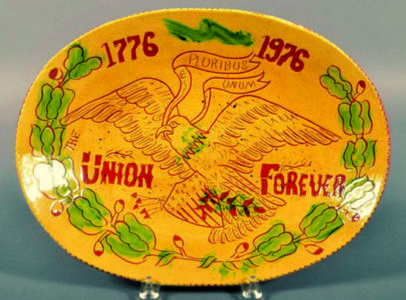
As we approach the 250th anniversary of the signing of the Declaration of Independence, many Americans are looking to the past. Fifty years ago, the country celebrated its bicentennial, and commemorative items are still collectible. This celebratory redware pottery platter, featuring the dates 1776 and 1976 along with an American eagle and a proud declaration of "The Union Forever," sold for $75 at an auction by Conestoga. It was made by Breininger Pottery, a Pennsylvania company founded by Lester Breininger (1935-2011), a devoted collector of antique American redware as well as a potter himself.
While many modern artists create innovative and unusual redware pieces, Breininger was passionate about keeping old techniques alive. Like the potters of previous centuries, he decorated his pieces, including this platter, with sgraffito designs and colorful slip. This platter is marked "L & B" on the back, meaning it was a collaboration between Lester Breininger and his wife, Barbara.
Redware is considered the first type of pottery made by European colonists in North America. It was made from local clay deposits, which contained iron, so the clay became a brick red color when it was fired. It was utilitarian, but that never meant it had to be plain. Some early pieces have very elaborate multicolor decorations that make them especially desirable (and expensive) today. While redware was made throughout colonial America, different regions, of course, developed their own decorating styles, which can help identify antique pieces. In Pennsylvania, redware was often decorated with Pennsylvania Dutch motifs, such as the brightly colored flowers and birds seen in fraktur folk art.
------
Q: My grandmother's water pitcher is at least 100 years old. It has an unusual shape that I have not seen in other pitchers. It has a round bottom, the neck has a ring around the base, and the opening tilts back diagonally from the spout. It has some painted flowers and gold stripes, but there is no mark or number on it. Can you tell me anything about it?
A: Unfortunately, glass is not often marked, which makes it difficult to identify -- and easy to reproduce. Knowing that your pitcher belonged to your grandmother helps confirm its age. Paying attention to the shape and decorations, as you did, can help identify the maker.
We have seen pitchers with the shape you describe listed in antique glass catalogs as "lemonade pitchers." They were usually sold as a set with tumblers. Several famous American glassmakers, including Fenton and Northwood, made pitchers like them. There are collectors' clubs dedicated to these companies, including the National Fenton Glass Society (nfgs.org), or to antique American glass in general, like the National American Glass Club (glassclub.org), that may be able to help you find additional information.
------
Q: I have an old gateleg table that has been in my family for at least 50 years. I would like to know more about it. How can I find out its real age and what it might be worth?
A: Gateleg tables were first made in the 17th century, putting them in the William and Mary furniture period, which lasted from about 1690 to 1720. (The fact that it is named after English monarchs is a clue that it pre-dates the Revolutionary War.) Gateleg tables have been made since then, and period furniture designs are frequently copied, sometimes so accurately that even museum professionals are fooled.
Colonial American styles saw a resurgence in popularity around the Centennial celebrations of 1876 and again in the 1920s to '30s, around the time of the sesquicentennial (150th anniversary). A general rule for estimating the age of a piece of family furniture is to count the number of generations before you that owned the piece and multiply that by 20, but this is not always accurate, and usually only gives you a maximum age. There are some clues in the type of wood and construction of your table that can help you determine its age. For example, the earliest gateleg tables usually have a drawer at one end, and walnut was a frequently used wood.
If you are comfortable with online sources, Kovels.com and AntiqueTrader.com have guides and articles that can help. The value of your table will depend on its age, type of wood, construction quality and condition.
------
TIP: Put a piece of cardboard between the back of a collector plate and the wire plate holder to keep the back from scratching.