
Trending
Kitaro Shirayamadani, also spelled Kataro, was born in Tokyo, Japan, and came to the United States as a young man. Already an accomplished porcelain painter, he initially worked for Fujiyama, an importer and decorator in Boston; then he accepted a job at the Rookwood Pottery Company in Cincinnati, Ohio, in 1887.
It was an opportune time for a Japanese ceramic artist to join an American pottery company. Japonisme was extremely fashionable in art and design, influenced by the recent opening of Japan to the West and exhibits of Japanese art at the Philadelphia Centennial Exhibition. Ceramic exhibits at the Centennial had also inspired the American Art Pottery movement and the creation of Rookwood.
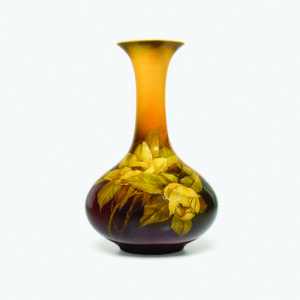
Like many artists who worked for the company, Shirayamadani created ceramics that fit with the Rookwood aesthetic and demonstrated his own unique talents. His work was displayed in a pottery show at the Art Institute of Chicago in 1897, and he contributed to the group of Rookwood ceramics that won a Gold Medal at the 1899 Exposition Universelle in Paris. He developed an electro-deposit technique to overlay metal on pottery, and his most famous (and most expensive) ceramics have silver or bronze deposits. Simpler pieces he made sell for high prices, too. A 14-inch-tall vase with magnolia flowers against a background of Rookwood's standard glaze sold for $1,320 at Toomey & Co. Auctioneers.
------
Q: I keep reading about vintage Pyrex that is worth a lot of money and I am curious about my Pyrex mixing bowls. I have a set that I put together from old family pieces and thrift store finds. There are four bowls of different sizes. The largest is yellow, the second is green, the third is red, and the smallest is blue. They are all white on the inside. Are they worth anything?
A: You have the Pyrex Primary Colors mixing bowl set, which was introduced in the 1940s. It was the first opalware Pyrex produced. The interior was opal white, and the outside colors were fired on. The smallest bowl, the blue one, holds 1 pint, and the largest, the yellow bowl, 4 quarts. They were redesigned in 1950 with a different foot. There was also a Reverse Primary set released in the 1970s, where the largest bowl was green. The bowls were advertised as heat-resistant, so they could be used for food preparation, baking, serving, and storing. They were one of Pyrex's most popular products and still are!
Even if you're not a dedicated Pyrex collector, the set is a nostalgic item for many people, so the bowls are highly sought. Complete sets can sell for anywhere from about $50 to $300, depending on their condition. Individual bowls sell online, at shops or auctions, and through pattern-matching services for buyers who want to replace missing or broken bowls.
------
Q: My mother had an early Barbie doll when she was a child that is now in my collection. The doll is hard plastic with a blond ponytail and curly bangs. It must be from the late 1950s or early 1960s. Is there a way to tell if it is the original Barbie? Any packaging is long gone!
A: There are a few ways to date an early Barbie based on marks and slight changes in appearance. The very first Barbie doll, released in early 1959, can be recognized by holes in the soles of her feet that fit into pegs on a pedestal stand. The version made later in the year, called "#2" by collectors, looks the same, except without the holes, and its pedestal did not have pegs. Both of these dolls have distinctive eyebrows shaped like an upside-down "V."
The "#3" Barbie, released in 1960, had curved eyebrows and blue eyes. In about 1961, the maker's mark on the doll changed slightly; instead of the trademark sign ("TM"), the word "Barbie" was followed by the registered trademark symbol. In 1962, the doll got a new style of curly bangs and wore a red one-piece swimsuit instead of the iconic black-and-white striped one. In 1965, the word "patented" was added to the mark.
------
TIP: Always fill a new vase with water and let it stand for 24 hours. Even commercial products can leak if not fired properly.
------
Kovels answers readers' questions sent to the column. Send a letter with one question describing the size, material (glass, pottery) and what you know about the item. Include only two pictures: the object and a close-up of any marks or damage. Be sure your name and return address are included. By sending a question, you give full permission for use in any Kovel product. Names, addresses or email addresses will not be published. We do not guarantee the return of photographs, but if a stamped envelope is included, we will try. Questions that are answered will appear in Kovels Publications. Write to Kovels, (Name of this newspaper), King Features Syndicate, 300 W. 57th Street, 41st Floor, New York, NY 10019, or email us at collectorsgallery@kovels.com.